

One Purple Cat and Four Second Acts
Riesling and the Moselland Purple Cat Bottle
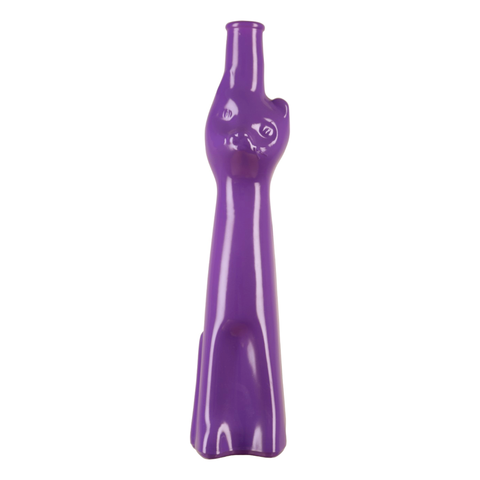
Some bottles leave with the recycling. This one looks as though it has already chosen a place on your bookshelf. Moselland’s Purple Cat Bottle brings German Riesling to dinner, then stays on as a flower vase, a twinkling accent, a reed diffuser, or a small piece of shelf sculpture. Quite a social calendar for an empty bottle.

A bottle with personality
The appeal is in the details: the molded face, the neat paws, the glossy purple finish. Set it beside simple glassware and linen and let it have its moment. A bottle this expressive needs very little decorating around it.
The cat behind the conversation
According to the legend shared by Moselland’s US importer, three wine merchants in Zell were choosing a barrel when a black cat fiercely guarded one of them. The merchants took that as a recommendation. The tale is associated with Zeller Schwarze Katz, meaning “Zell Black Cat.” Apparently, feline opinions have been influencing purchases for quite some time.
Moselland’s cat bottle began in black before expanding into other colors. The story belongs to the bottle’s inspiration; it does not mean every cat-shaped bottle comes from the same vineyard.
What is inside the purple bottle
The importer describes the purple Riesling with pear and citrus notes, sweetness, and crisp acidity. Expect a fruity wine with a fresh edge. If you usually choose very dry whites, that sweetness is useful to know before you pour.
Meet Riesling beyond the bottle
Riesling is a white grape with impressive range: it can make bone-dry wines, gently sweet styles, and richly sweet dessert wines. A peachy aroma alone does not tell you how sweet the wine will taste. Fruit character and sweetness are different things, which makes this grape worth exploring beyond a single bottle.

Rheinhessen south of Mainz • Photo: KaiBorgeest / Wikimedia Commons

Cochem on the Mosel • Photo: Quintessenz76 / Wikimedia Commons
Three facts to bring to dinner
Put it on the calendar. March 13 celebrates the earliest known written mention of Riesling, in a cellar record dated 1435. That is a very respectable paper trail for something we are still happily discussing over dinner.
Sweet, with a little snap. Riesling ripens slowly and is known for lively acidity. That mouthwatering quality helps balance sweetness and makes the grape useful at the table. Typical aromas can include apple and peach, though the vineyard and winemaking shape the final character.
It has a sparkling alter ego. Riesling is also used to make Sekt, German sparkling wine. This purple bottle is a still wine, but the grape has a sparkling side worth remembering for another occasion.
A little German geography
Germany is home to roughly 45% of the world’s Riesling vineyard area, according to the German Wine Institute’s 2024 figures. Its Riesling story reaches well beyond the famous Mosel.
Rheinhessen, Germany’s largest wine region, is known for its rolling “thousand hills.” Romans cultivated vines on the left bank of the Rhine, and winegrowing still shapes its villages. It is a useful reminder that Germany has a wine-country story every bit as inviting as its beer halls.
Dinner with a German accent
For this bottle, we would build dinner around crisp textures, gentle spice, and a little richness. Serve the wine chilled, then let it warm slightly in the glass as you explore the aromas. No elaborate tasting ritual required.

What we would serve
Schnitzel with lemon: the contrast between a golden, crisp coating and a bright white wine is an excellent place to start. Keep the sides simple so the plate feels fresh rather than heavy.
Onion tart: for a German-inspired menu, try a savory tart with soft onions and a crisp base. Their mellow sweetness makes an inviting partner for the wine’s fruit. Cut it into small squares to pass around before dinner.
Spicy tuna rolls or ginger shrimp: take the evening in another direction with sushi or seafood. A little sweetness offers a pleasant contrast to moderate chili heat; avoid so much spice that the wine disappears.
Brie and sliced pear: the easy option when cooking is not on the agenda. Creamy cheese and fresh fruit give you a relaxed first course with almost no preparation.
Four second acts for the bottle
After the last pour, wash the bottle and let it dry. Its sculptural shape deserves another outing.
Flower vase: add water and a few slender flower stems. Fairy-light accent: loosely wrap battery-powered micro LEDs around the outside. Reed diffuser: use a suitable diffuser refill and reeds long enough to reach the liquid; place it on a protective tray and retire it from beverage use. Shelf sculpture: display it beside books or ceramics and let that purple finish do the work.
The wine starts the conversation. The bottle gets to stay for the next one.
Shop the Moselland Purple or Black Cat Bottle at Case Wine Life
Further reading
Halby Marketing — Cat collection and wine notes
German Wine Institute — Riesling


Comentarios (0)
No hay comentarios todavía. Sé el primero en comentar.